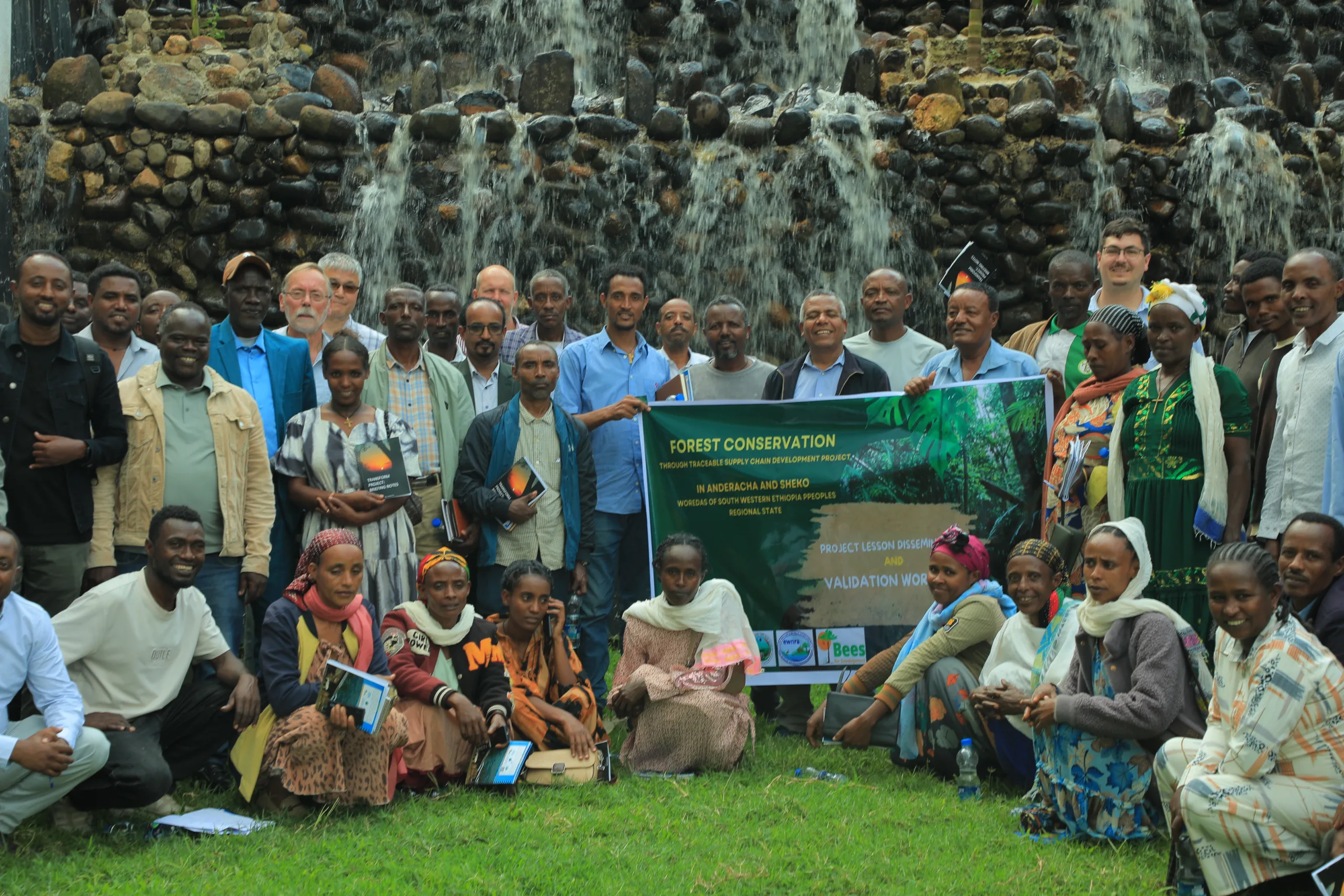
Mizan-Aman, 18 August 2026
A Project Lesson Dissemination and Validation Workshop for the Forest Conservation through Traceable Supply Chain Development Project was held in Mizan-Aman, bringing together government representatives, development partners, researchers, community representatives, cooperatives and Forest Management Associations (FMAs) to review three years of project implementation in Anderacha and Sheko Woredas of Southwest Ethiopia Peoples’ Regional State (SWEPRS).
Funded by Jersey Overseas Aid (JOA), the project is implemented by Ethio Wetlands and Natural Resources Association (EWNRA), the University of Huddersfield and Bees for Development, in collaboration with government partners including Ethiopian Forestry Development and government administrations from the regional level down to the woreda level.
The opening remarks highlighted EWNRA’s long-standing contribution to Southwest Ethiopia through collaboration with government institutions and development partners. Speakers emphasized the contribution of the project to Ethiopia’s efforts toward climate-resilient green development, while supporting local households through sustainable forest-based livelihoods, particularly wild coffee and forest honey.
In his Welcome Speech Ato K. Eshetu Shambel, Head of Bench–Sheko Zone Administration Office and representative for the Zone’s Administrator, welcomes participants to the Mizan-Aman town and Bench Sheko Zone, which are enriched by natural resources, producers and exports from its natural products like coffee, spices and fruits. He also appreciated EWNRA’s interventions in the zone and the region at large.
Mr. Temesgen Kebebe Finance Office Head of the region (SWEPRS) who made the opening remarks, Mentioned EWNRA’s 23-year contribution in the region by collaborating with government bodies and donors. He elaborated these contributions helped the national strategy of building climate-resilient green development. He said the project “Forest Conservation through Traceable Supply Chain Development for Wild Coffee and Forest Honey in Southwest Ethiopia” is part of that strategy. Because this project supports many households, particularly in Sheko and Anderacha Woredas. Today’s discussion will entertain the experiences of the project implementation in the past 3 years, he added.
Desyalew Fantaye, Project Coordinator of the TRANSFORM Project, presented the workshop objectives and program overview, setting the stage for experience sharing, validation of lessons and collaborative discussion.
Ahmid Said, Director of the Forestry Program at EWNRA, presented the organization’s extensive engagement in SWEPRS. He highlighted EWNRA’s transition toward an integrated landscape approach that links environmental conservation with socio-economic development. He also discussed EWNRA’s Participatory Forest Management (PFM) and REDD+ models, which support community forest governance and strengthen the role of local Forest Management Associations.
Ahmid further highlighted progress in developing traceable, high-value value chains for wild coffee and forest honey, creating alternative income opportunities for local communities while helping reduce pressure on forests and agricultural encroachment. He emphasized the importance of sustained collaboration among stakeholders, from federal forestry institutions to regional and woreda administrations.
Professor Adrian Wood of the University of Huddersfield shared his experience and perspective on Southwest Ethiopia, emphasizing the global importance of the region’s biodiversity and its role as a vital water source. He stressed the need to build resilient, community-supported systems capable of protecting both forests and local livelihoods for future generations.
Matthew Snell (PhD) presented an overview of the TRANSFORM Project, including its objectives and lessons learned. He emphasized that the future of the region’s forests depends on active multi-stakeholder collaboration, with community, cooperative and government partners working together to advance forest conservation alongside sustainable and traceable supply chains.
Dr. Byongjun (Phil) Hwang of the University of Huddersfield presented analysis on changes in forest canopy cover and tree loss. He highlighted the delicate balance between immediate economic demands and long-term ecological stability, warning that forest loss and climate change could pose serious risks to vital resources, including wild coffee production, biodiversity and ecosystem services.
Representatives of Woreda Forest Management Associations, cooperatives and forest-dependent communities shared first-hand experiences from project implementation. They highlighted economic opportunities created through traceable and premium value chains for wild forest coffee and honey, which have contributed to improved household incomes.
At the same time, participants raised concerns about tree loss, forest degradation, climate change and agricultural encroachment. These discussions provided important local perspectives for identifying practical measures to strengthen forest protection and sustainable livelihoods.
Closing the workshop, Ato Kabtamu Girma, CEO of Natural Forests at Ethiopian Forestry Development, emphasized the high stakes of forest conservation in Southwest Ethiopia. He underscored the importance of Participatory Forest Management (PFM) in protecting natural resources while securing community livelihoods.He warned that continued deforestation could result in biodiversity loss, soil degradation and climate-related changes that would undermine the region’s valuable wild coffee and forest honey value chains. He called on all partners—from international researchers and development organizations to regional and woreda administrations and local communities—to translate the strategic actions identified during the workshop into measurable impacts on the ground.
The workshop concluded with discussions on strategic actions, group presentations and agreement on the way forward and next steps, reinforcing the shared commitment to sustainable forest conservation and community-based natural resource management in Southwest Ethiopia.